

New generation pawnbrokers "take over" alternative finance
Modern pawnshop services are asserting their absolute leading position in the alternative financial ecosystem.
Modern pawnshop service is asserting its absolute leading position in the alternative financial ecosystem.
After years of explosive growth in the number of users and products, the alternative finance sector, including modern pawnshops, buy now and pay later (BNPL), peer-to-peer lending (P2P lending) and short-term lending (Payday Loan), has officially closed the period of extensive development to move into a cycle of standardization, purification and quality competition. quantity.
The latest data from FiinGroup shows that the outstanding debt scale of the alternative finance market in Vietnam has reached about 283 trillion VND. This number confirms the growing role of the alternative financial market as an increasingly obvious additional piece of the puzzle, filling the gap that the traditional banking system has not yet fully served.
But behind that impressive growth picture is a fierce screening that is silently taking place.
As the market becomes more mature and the legal corridor is increasingly perfected, the advantage no longer belongs to the fastest growing units, but to businesses that possess the best risk management capabilities, the strongest technology platforms and the ability to convert scale into sustainable profits.

The pawnshop sector accounts for 67.9% of the revenue market share of the entire alternative finance industry. Source: FiinGroup
The rise of 'new generation pawnshops'
Most prominent in today's alternative financial ecosystem is the tectonic shift of the pawnshop service segment. Data from FiinGroup shows that the pawnshop sector accounts for 67.9% of the industry's revenue market share by 2025. But, a notable highlight is that, in the past, the market was mainly operated by tens of thousands of small traditional pawnshops, now new generation pawnshop chains are gradually changing the game.
In 2020, modern pawnshops only accounted for about 1.2% of the total number of business points in the market, then by 2025, this proportion has increased to 5%. Although still a modest number in terms of quantity, this is the group of businesses that is controlling the majority of revenue growth and outstanding debt.
The difference lies in the operating model. Instead of just providing traditional asset pledging services, "new generation pawnshop" chains have applied credit scoring systems, centralized data management, asset appraisal using technology and providing online services.
This helps them expand their customer base significantly faster than small retail stores.
Actual numbers have proven: the scale of outstanding debt in the entire pawn market of "new generation pawnshop" chains has increased from about 3.5 billion USD in 2019 to 10.3 billion USD in 2025, or nearly tripled in just six years.

The rise of "new generation pawnshop" chains. Source: FiinGroup
According to FiinGroup, the biggest growth driver comes from vehicle registration loan products, a model that allows customers to continue using the vehicle during the loan period. This is becoming a key product of modern pawnshop chains thanks to its ability to reach a large number of customers in the economy.
In the group of leading businesses in the market, F88 continues to be the most prominent name. Accordingly, by the end of 2025, this business will own about 950 stores nationwide, far ahead of competitors such as Golden Friend or Srisawad.
It is worth noting that F88 not only expanded its network but also demonstrated the ability to turn scale into real financial efficiency.
Specifically, outstanding mortgage loans of businesses reached VND 7,216 billion at the end of 2025, an increase of 57% compared to the beginning of the year. Revenue reached about 3,840 billion VND, while pre-tax profit amounted to 900 billion VND.
Profitability indicators also show a significant gap between the modern pawnshop model and many traditional consumer finance companies. Accordingly, F88's ROAA reached 11.7%, many times higher than the average of 1.7% of consumer finance companies. Meanwhile, ROAE reached 32.7%, far exceeding the average level of about 10.7%.
In particular, reducing credit costs to 12% and cost-to-income ratio (CIR) to only 51.7% shows that the business is getting closer to the operating standards of the leading financial retail models in the region.
If modern pawnshops are a bright spot in terms of profitability, the field of Buy Now Pay Later (BNPL) is witnessing a profound change in development model. If in the previous period, BNPL was a fertile land for independent fintech startups, then by 2025-2026, the situation has completely changed.
While the number of active BNPL platforms increases from 4 (2020) to 14 (2025), the real growth driver is shifting strongly to the collaborative model.
More and more BNPL products are being directly integrated into e-commerce, digital banking and e-wallet platforms such as Shopee PayLater, TikTok Shop Pay Later, LazPayLater or cooperation models between digital banks and retailers.
The reason for this shift is quite obvious. Instead of having to spend hundreds of billions of dong to find new customers, digital ecosystems already have millions of regularly active users. They also hold huge amounts of behavioral data to help assess debt repayment ability more accurately.
In the context of increasingly expensive customer attraction costs and increasingly high risk management requirements, data advantage becomes the deciding factor in the game's success or failure. This causes the BNPL market to shift from an independent fintech model to an "embedded finance" model - finance embedded directly into the consumer experience.
The new legal framework will "reshape the market"
One of the reasons why the alternative finance market is strongly differentiated in the current period lies in the level of completion of the legal corridor.
While the Payday Loan and BNPL models still do not have their own legal framework, and P2P Lending has just been implemented in the form of a controlled trial (sandbox), the pawnshop industry is benefiting from a relatively clear regulatory system. This important turning point comes from Decree 282/2025/ND-CP.
According to FiinGroup, this is a document of special significance to the formal pawnshop industry as it first addresses many legal gaps that have existed for many years. Accordingly, one of the most notable points is the recognition of an exception that allows the mortgage of assets not to be retained if the parties have a legal agreement. This regulation creates a clear legal basis for vehicle registration loan products, the core business of many modern pawnshop chains.
At the same time, Decree 282/2025/ND-CP also strengthens sanctions against pawnshop models to perform unsecured loans or loans through applications without collateral. This helps create a clearer distinction between legitimate financial activities and disguised black credit.

The "new generation pawnshop" chains in Vietnam. Source: FiinGroup.
In addition, the implementation of Project 06 and the requirement to integrate electronic identity authentication through VNeID are creating significant investment pressure for small retail stores. But for large chains, this is an opportunity. Because businesses that have invested early in technology can take advantage of digital data to improve appraisal quality, reduce fraud risks and make business operations transparent.
In other words, the same policy is creating two opposite effects: increasing pressure on small groups and expanding competitive advantages for leading groups.
Besides technological and legal factors, the alternative finance market is also witnessing a significant change in customer structure. According to data from FiinGroup, the group of adults aged 22-50 years old is still the core customer base with about 43 million people, equivalent to nearly 69% of the adult population.
However, the focus of the next growth phase lies in generation Z. With a scale of about 20.5 million people, this is the generation born with the internet, familiar with digital transactions and has a more open attitude towards consumer credit. Unlike generation Y, which is cautious and prioritizes accumulation before spending, many people of generation Z see credit as a tool to support life experiences and meet immediate needs.
This feature makes digital financial products, BNPL or online loan services especially attractive to young customer groups.
However, it also poses new requirements for financial institutions. Because, generation Z is not only looking for capital but also demands a seamless experience, fast processing speed and the ability to interact completely on a digital platform. This forces alternative finance businesses to redesign their products, processes and customer approaches if they want to remain competitive in the next decade.
According to FiinGroup's forecast, Vietnam's alternative finance market still has large growth potential in the period 2025-2030.
In the most positive scenario, when the economy recovers strongly, household income improves and the legal framework for fintech is synchronously completed, the total outstanding debt of the entire industry can grow at a compound rate of 22-25% per year.
In the base scenario, the growth rate is forecast at 17-20%, with capital flows increasingly focused on businesses with outstanding capital capacity and risk management systems.
Even in the most conservative scenario, the market can still maintain growth of 13-16% per year. However, the differentiation will become deeper, when models lacking a clear legal corridor or insufficient technological investment resources will face many difficulties in survival.
Source: TheLeader — theleader.vn. The article is reposted for the purpose of sharing knowledge for the founder and investor community in the ecosystem HCM VIF.
Chuyên mục & thẻ
Related news
 Finance - Banking10/2026
What models are Vietnamese banks making money under?
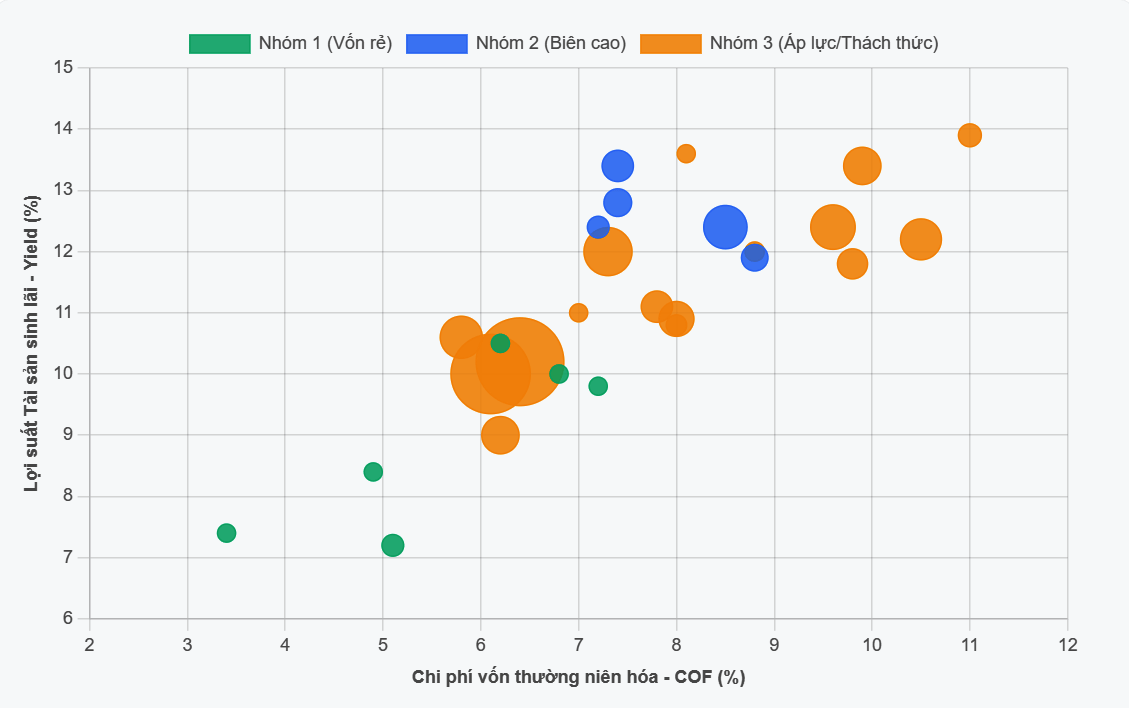
Data for the first quarter of 2026 shows that Vietnamese banks are pursuing three different business models: groups with cheap capital advantages, high profit margin groups and groups under pressure to mobilise capital. Each model brings a configuration
 Finance - Banking11/2026
Which bank's ROA is the highest?
Bank ROA shows a clear differentiation in asset utilization efficiency. Techcombank leads the entire system, while Vietcombank continues to be the state-owned bank with good return on assets
 Finance - Banking12/2026
Bank ROE: Which bank is generating the most profit per capital?
ROE of Vietnamese banks shows a clear difference in the efficiency of equity use. ABBank leads in ROE index, but HDBank and MBBank are the banks that maintain high and stable profitability.